


Compare Trustpilot, Judge.me, Loox, Yotpo and REVIEWS.io for loyalty-led brands that need reviews, referrals, UGC, reputation management and retention data.
A strong loyalty strategy is not just about points. It’s about creating a loop where customers buy, engage, share, return and give you more data to personalize the next interaction.
Reviews play a key role in that loop. They give customers a rewardable post-purchase action, give referred shoppers proof before they buy, and give marketers content and customer signals to use in emails, segments and retention campaigns.
There’s also a reputation layer. Public review profiles help new shoppers decide whether they trust you, especially when they come through a referral or ask AI tools about your brand. You can’t build a loyal customer base without brand credibility.
So the best setup isn’t a tool for loyalty and a tool for reviews. It’s a system for reviews, rewards, referrals, retention and reputation.
No review software comparison would be complete without Trustpilot. It’s one of the most recognizable public review platforms, and its role is becoming more important as AI search changes how shoppers validate brands before buying.
A referred shopper may trust the person who sent them the link, but they may still check whether your brand looks credible. Trustpilot helps at that validation stage. And as one of the top domains cited by ChatGPT, it’s becoming a non-negotiable.
The gap is the reward loop. Trustpilot isn’t where you incentivize reviews with loyalty points or discounts. Its value is public credibility, not loyalty-led review collection.
Product Reviews are available as an add-on - but they’re not a core feature and loyalty integrations are few. So if you want customers to earn points for product reviews, photo reviews or video UGC, you’ll need another review and loyalty layer alongside it.
Judge.me is the practical, budget-friendly option. It gives you a straightforward way to collect product reviews, store reviews, photo reviews and video reviews without a big platform commitment.
It can also support basic reward loops. You can automatically send coupon codes after a customer leaves a review, and Judge.me transparency badges let you mark reviews that earned a reward.
That gives you a useful starting point: more reviews, simple incentives and a clear way to show when a review was rewarded.
Where Judge.me starts to thin out is strategy depth. It’s still review-first. If you want advanced loyalty tiers, referrals, deeper Klaviyo personalization and public reputation management, you’ll need to build around it with other tools.
Judge.me can work with Klaviyo for review request events and email content, which is helpful for basic retention flows. It’s not the same as having review and reward data sitting inside Klaviyo as reusable objects.
Loox is strongest when visual proof drives conversion.Its strength is photo and video review collection, so it’s useful for brands where UGC does much of the selling - especially in fashion, beauty, lifestyle, home and accessories.
Loox also connects well to advocacy. You can offer discounts for photo or video reviews, and Loox can show a “Rewarded” badge on incentivized photo or video reviews. It also integrates with LoyaltyLion, letting you award tiered points for text, photo and video reviews.
The Klaviyo integration helps keep review requests and follow-ups connected to email. That’s useful when your lifecycle team wants more control over post-purchase review collection.
The compromise is scope. Loox is great for visual advocacy, but thinner if you need review data depth, public reputation routing or AI-visible brand credibility.
Yotpo is popular for good reason. If you want reviews, loyalty and referrals from one vendor, it’s one of the strongest options in the market.
The appeal is convenience. Product reviews, UGC, loyalty points and referrals can all sit inside the same broader suite. Yotpo also integrates with Klaviyo, so loyalty and referral data can support segments, flows and customer targeting.
Yotpo is also credible on incentivized product reviews. When incentives are offered through Yotpo, reviews can be automatically marked as incentivized and displayed with an on-site badge.
The trade-off is public reputation control. Yotpo is strong for reviews, loyalty and referrals in one suite, with Klaviyo connected around it. But its strength sits mainly inside its own reviews and retention ecosystem. If Trustpilot, AI search visibility or wider public reputation management are part of your strategy, that layer still needs to be handled separately.
REVIEWS.io is strongest when reviews need to support loyalty, retention and public reputation at the same time.
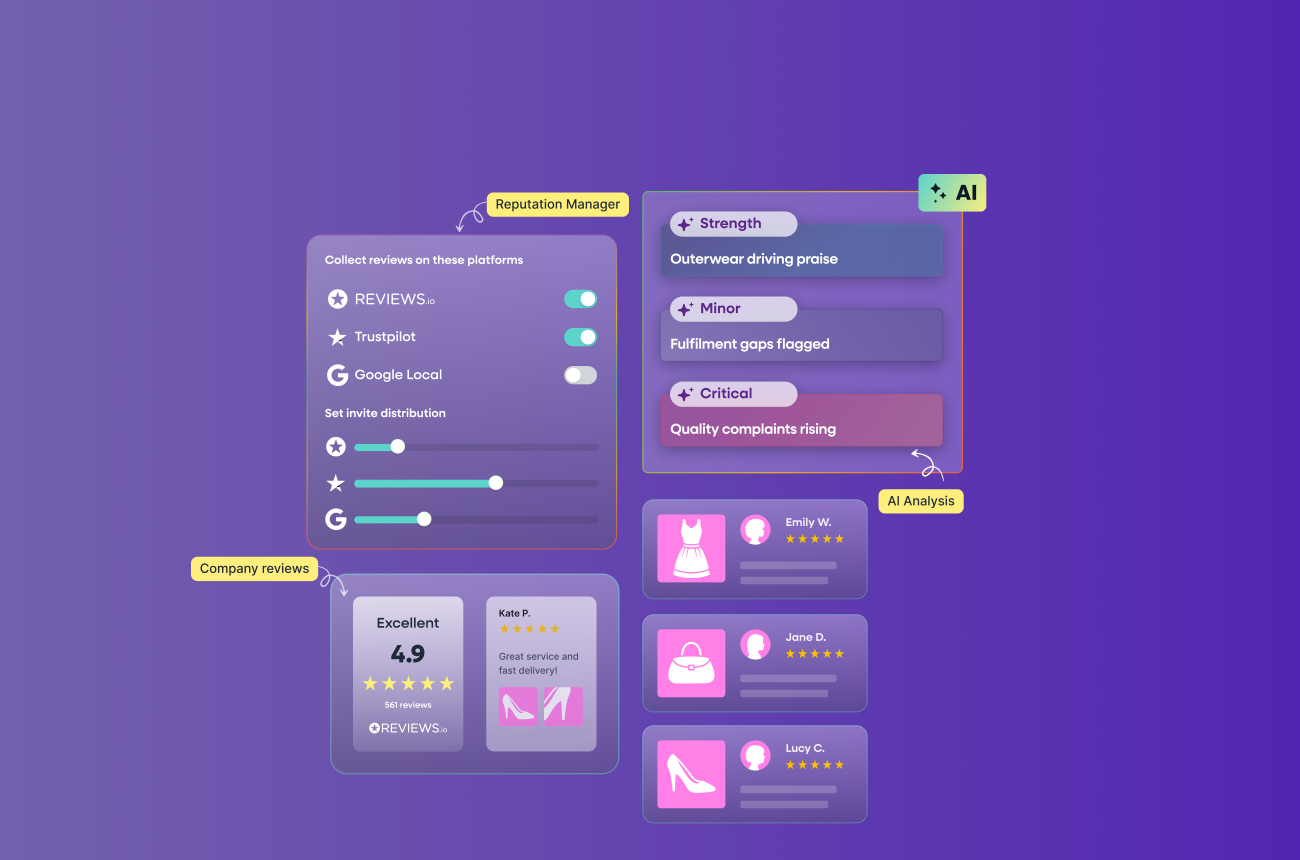
Its key advantage is Reputation Manager, which lets you distribute review invitations across selected third-party platforms, including Trustpilot and Google Local where relevant. That means public trust signals can sit alongside your review and loyalty strategy, rather than being managed as a separate side project.
Paired with Influence, REVIEWS.io lets you reward product review actions with points and keep incentivized review labeling connected to the review collection process. Influence handles the rewards and referrals; REVIEWS.io handles the review content and disclosure.
The Klaviyo connection is another advantage. REVIEWS.io supports Review Objects, and Influence supports Reward Objects, so review and reward data live in Klaviyo as reusable records rather than one-time events. That makes it easier to segment, personalize and build flows around reviews, rewards and referral potential.
Loyalty doesn’t start after someone buys. It starts when they decide whether your brand is worth trusting in the first place.
Points, rewards and referral offers can bring customers back, but reviews and public reputation give those customers - and the people they refer - the confidence to act.
The strongest setup connects both sides. You need product reviews and UGC that can be rewarded properly, review and reward data that can power retention campaigns, and public reputation signals that make your brand credible beyond your own site.
That’s where REVIEWS.io and Influence make the strongest case. Together, they support the full system: reviews, rewards, referrals, retention data and reputation.
Yes, you can reward customers for honest product reviews, photo reviews and video UGC. You should not reward company reviews, and any incentivized product review should be clearly disclosed.
No. Trustpilot and Google do not allow businesses to offer loyalty points, discounts, gifts or perks in exchange for public company reviews.
Yotpo is a good option if you want reviews, loyalty and referrals in one connected suite. If you also want to manage Trustpilot and wider public reputation, a setup like REVIEWS.io + Influence gives you more control.
Judge.me is a strong low-cost option for collecting reviews and offering simple rewards. For an advanced loyalty strategy and brand reputation management, it’s not complete enough on its own.